Data Governance Has Never Been More Sophisticated. Why is Trusted Data Still So Hard?
xLytix Perspectives
POSITION PAPER · DATA GOVERNANCE
Modern organisations have access to sophisticated data catalogues, automated lineage, data quality platforms, classification, access controls and increasingly AI-assisted governance. Yet many still struggle to answer basic questions consistently: What does this data mean? Can we trust it? Who owns it? What will break if it changes?
10 min read · August 2026
In This Paper
- What Is Modern Data Governance?
- We Don’t Have a Shortage of Governance Technology
- Why Does Data Governance Still Struggle?
- The Governance-After-the-Fact Problem
- A Catalogue Is Not the Same as Governed Data
- One Problem. Three Different Realities.
- The Enterprise Challenge: Scale and Fragmentation
- The Mid-Market Challenge: Capacity and Process
- The Smaller Organisation Challenge: Practical Governance
- Where xLytix Takes a Different View
- Governance in the Flow of Work
- From Technical Lineage to Business Understanding
- Data Quality Must Be Operational
- Why AI Makes Governance More Important
- Complement the Existing Data Platform
- What Should Organisations Measure?
- From Governance Programme to Governed Data
What Is Modern Data Governance?
Data governance is the set of responsibilities, controls, definitions and processes that help an organisation know what its data means, who is accountable for it, whether it can be trusted, how it may be used and how it changes across its lifecycle.
Modern governance platforms increasingly combine metadata catalogues, lineage, data quality, business definitions, ownership, classification and access controls. Microsoft Purview, for example, combines Data Map and Unified Catalog capabilities for metadata, governance domains, data products, quality and access; Databricks Unity Catalog provides access control, lineage, auditing, discovery, classification and quality capabilities for data and AI assets.
The technology is increasingly capable.
The harder problem is making governance part of how people actually create and use data.
Governance technology has advanced dramatically. Governance operating models often have not.
We Don’t Have a Shortage of Governance Technology
The modern governance landscape is sophisticated.
Organisations can automatically scan technical metadata.
They can build searchable catalogues.
They can classify sensitive information.
They can trace data lineage.
They can implement ownership and stewardship.
They can measure quality.
They can enforce access controls.
They can increasingly govern both data and AI assets.
Collibra’s catalogue integrates metadata from databases, lakes, warehouses, enterprise applications, ETL tools and BI systems, while its lineage capabilities map data movement across the lifecycle. Microsoft Purview connects metadata discovery with glossary concepts, domains, data products and data quality. Databricks Unity Catalog automatically tracks lineage and enforces governance within the Databricks environment.
These are significant capabilities.
So the xLytix position cannot simply be:
“We have lineage, quality and a glossary.”
The market already has excellent technology for each.
The more important question is:
Why does governance still feel like a separate initiative rather than a natural characteristic of the data itself?
Why Does Data Governance Still Struggle?
Consider a typical lifecycle.
A source is connected.
A data engineer creates a pipeline.
Another engineer creates transformations.
An analyst builds a model.
A dashboard is published.
People start using it.
Then someone asks:
Who owns this dataset?
What does this field mean?
Where did this KPI originate?
Which source contributes to this report?
Is customer information classified as sensitive?
What will be affected if this column changes?
Governance teams then begin reconstructing the answers.
The organisation already created much of the information needed for governance during the data lifecycle.
But the context was distributed across tools, code, tickets, documentation and individuals.
Governance therefore becomes an exercise in reconstruction.
That is expensive and difficult to sustain.
The Governance-After-the-Fact Problem
A traditional pattern looks something like:
Build → Deploy → Use → Catalogue → Document → Govern
This has an obvious weakness.
Governance arrives after the most valuable context has already been created.
The engineer who understood the source may have moved to another project.
The analyst who defined the calculation may not remember every assumption.
The dashboard may contain additional business logic.
The documentation gradually falls behind the implementation.
The organisation ends up maintaining two realities:
the data
and
the documentation describing the data.
When those diverge, trust declines.
The problem is not necessarily poor governance discipline.
It is often the architecture of the operating model.
If governance relies primarily on people documenting data after it has been created, keeping governance current becomes a permanent administrative task.
A Catalogue Is Not the Same as Governed Data
A modern data catalogue can be enormously valuable.
It helps organisations discover assets, metadata, definitions, ownership and lineage. Microsoft describes Unified Catalog as a searchable governance experience for curating assets, managing data quality and connecting technical assets with business concepts.
But the presence of a catalogue does not automatically mean the underlying data is governed.
A catalogue can tell us:
This table exists.
Governance needs to answer:
Should we use it?
A glossary can tell us:
This is the definition of Customer.
Governance needs to answer:
Is that definition actually reflected in the model used by Finance?
Lineage can show:
This field flows into that report.
Governance also needs to answer:
What business decision depends on it?
Quality tooling can report:
97% completeness.
Governance needs to establish:
Is 97% acceptable for this business purpose?
This distinction matters.
Metadata describes data. Governance establishes responsibility and trust around its use.
One Problem. Three Different Realities.
| Large Enterprise | Mid-Market | Smaller Organisation | |
| Governance environment | Multiple catalogues, platforms and policies | Growing requirements, limited specialists | Usually informal |
| Primary challenge | Scale and fragmentation | Capacity and adoption | Practicality |
| Typical symptom | Governance programme becomes complex | Governance becomes someone’s additional job | Knowledge stays with individuals |
| Economic issue | Administration and coordination | Specialist capacity | Enterprise governance cost |
| Main risk | Inconsistent governance across domains | Governance falls behind delivery | No repeatable controls |
| Opportunity | Embed and federate | Simplify | Make governance practical |
The governance requirement may be universal. The appropriate operating model is not.
For the Enterprise, the Problem Is Scale and Fragmentation
Large organisations frequently have sophisticated governance programmes.
They may have:
- data offices;
- data owners;
- stewards;
- regulatory teams;
- enterprise catalogues;
- quality platforms;
- security controls;
- privacy processes;
- domain-specific governance;
- multiple cloud environments.
The difficulty is scale.
Thousands of tables become tens of thousands of fields.
Data moves through integration platforms, warehouses, transformation tools and BI environments.
Definitions evolve.
Ownership changes.
New data products appear.
AI applications introduce new consumers.
The governance team cannot manually supervise every asset and every change.
Modern platforms recognise this challenge. Microsoft advocates a federated governance approach in which central governance establishes standards while domain experts participate directly; Databricks similarly embeds governance beneath data and AI interactions within Unity Catalog.
For the enterprise, the challenge therefore becomes:
How do we move from a governance team governing data to an operating model in which the organisation creates governed data by default?
For the Mid-Market, the Problem Is Capacity and Process
Mid-market organisations increasingly face governance expectations that once belonged mainly to large enterprises.
They handle personal information.
Customers expect security.
Boards expect reliable numbers.
Auditors require traceability.
AI initiatives need trusted data.
But the organisation may have:
one data architect;
a small engineering team;
a few analysts;
and no dedicated data-governance function.
The traditional answer can become another programme:
buy a catalogue;
establish a glossary;
appoint stewards;
define workflows;
create policies;
launch a quality initiative.
Each step may be sensible.
Collectively they can become more governance infrastructure than the organisation can realistically operate.
The result is often partial adoption.
The tool exists.
The catalogue exists.
The governance process exists.
But delivery continues elsewhere.
The mid-market does not need less governance.
It needs governance requiring less organisational machinery.
For Smaller Organisations, the Problem Is Practical Governance
A smaller company may never create a formal Data Governance Office.
That does not mean it has no governance problem.
Someone still needs to know:
Which version of customer data is correct?
Who is allowed to access payroll data?
Which spreadsheet contains the approved forecast?
What does “active customer” mean?
Where did this dashboard number come from?
Who changed the calculation?
Smaller organisations often govern through people rather than systems.
“Ask Sarah — she knows how the report works.”
“Finance owns that spreadsheet.”
“Don’t change that column; the monthly report depends on it.”
This can work while the organisation is small.
It becomes fragile as people, systems and requirements grow.
For smaller organisations, the proposition should therefore not be enterprise governance reduced in price.
It should be:
Make basic governance an automatic property of normal data work rather than a separate corporate programme.
Where xLytix Takes a Different View
xLytix starts from a simple idea:
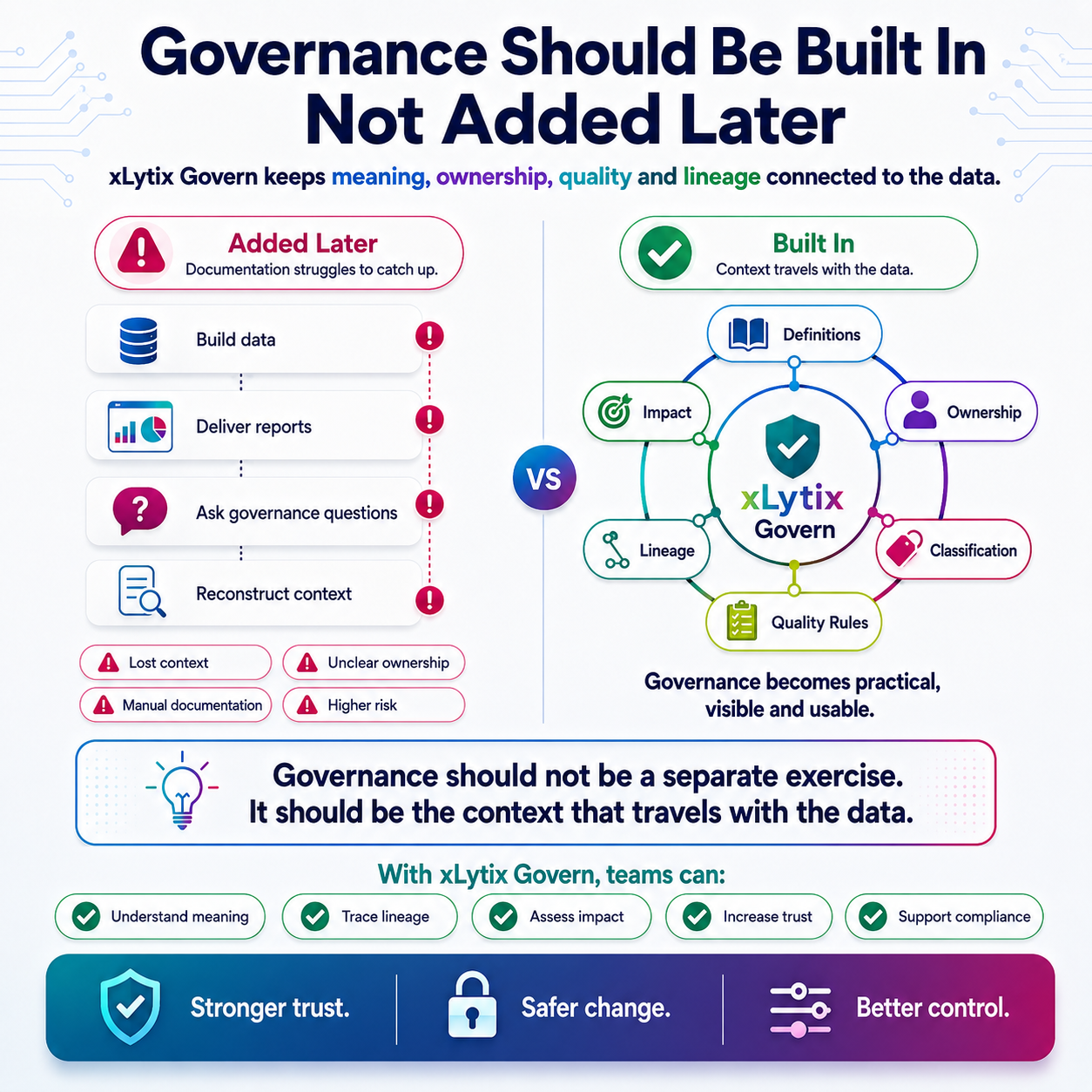
Governance should be created with the data, not added to it later.
Within xLytix, governance sits inside the same wider lifecycle as data ingestion, modelling, analytics and operations.
The current platform connects lineage, business glossary information, ownership, data quality, access controls and traceability with the models, fields, calculations and connections being created.
This changes the sequence from:
Create Data → Document Data → Govern Data
to:
Create Governed Data
That difference looks small.
Operationally it is significant.
Governance in the Flow of Work
Consider what happens when a model is being created.
At that moment the platform already knows important information:
the source;
the fields;
the joins;
the calculations;
the output;
the dependencies.
That is the natural moment to establish lineage.
When a field is defined, that is the natural moment to associate:
business meaning;
description;
ownership;
classification;
quality expectations.
When a model is published, that is the natural moment to understand:
where it is used;
what depends on it;
whether it meets the expected controls.
The governing principle becomes:
Capture context at the point where context exists.
This reduces the need to reconstruct information later.
From Technical Lineage to Business Understanding
Modern lineage technology is increasingly powerful.
Databricks Unity Catalog can use lineage for impact analysis, root-cause investigation and tracking how sensitive data moves through downstream assets. Microsoft Purview describes lineage as useful for troubleshooting, quality analysis, compliance and impact analysis.
But lineage becomes more valuable when it crosses the boundary between engineering and business understanding.
A technical lineage path might say:
ERP.ORDER_VALUE
↓
RAW_ORDERS.ORDER_VALUE
↓
FCT_SALES.NET_VALUE
↓
SALES_SUMMARY.REVENUE
That is valuable.
A business-oriented view asks:
Which KPI uses this field?
Which dashboard will change?
Which business process depends on the result?
Who should care if it fails?
This is the direction xLytix governance should ultimately support.
Lineage should not merely show where data travelled. It should help explain why the journey matters.
Data Quality Must Be Operational
Quality is another area where technical measurement alone is insufficient.
Consider:
Customer Email Completeness: 91%
Is that good?
For a finance report, perhaps email completeness is irrelevant.
For a marketing campaign, it may be critical.
For a regulatory notification, 91% may be completely unacceptable.
Microsoft Purview’s current quality capabilities similarly frame data quality in terms of governance domains and owners overseeing data health, reflecting the fact that quality must be connected to its purpose and accountability.
The xLytix direction should therefore distinguish:
technical quality
from
business fitness for use.
A rule such as:
customer_id IS NOT NULL
is technical.
The business context is:
Every confirmed order must be attributable to a valid customer before daily revenue reporting is published.
Quality becomes substantially more useful when the organisation understands both.
Why AI Makes Governance More Important
AI creates a tempting assumption:
If AI can discover, query and interpret data automatically, perhaps governance becomes less important.
The opposite is more likely.
An AI system can generate a technically valid query against the wrong table.
It can use an outdated KPI.
It can interpret two apparently similar customer fields differently.
It can provide an answer from data the user should not access.
It can confidently describe a relationship whose business meaning has never been established.
Modern platforms are consequently extending governance into AI itself. Databricks now explicitly positions Unity Catalog as a governance layer for data and AI assets, including lineage, classification, quality and access control. Microsoft similarly describes reliable data quality as important for AI-driven insights and recommendations.
The implication is important:
AI makes metadata easier to generate. It does not make accountability unnecessary.
For AI-ready data, organisations need:
trusted sources;
consistent definitions;
relationships;
ownership;
quality;
lineage;
permissions;
business context.
Without these, AI can make access to inconsistent information faster.
That is not the same as better decision-making.
Complement the Existing Data Platform
xLytix Govern should not be positioned as though every customer needs to discard existing governance technology.
Large enterprises may already use Purview, Collibra, Unity Catalog or another enterprise governance platform.
Those platforms provide sophisticated capabilities.
The more useful question is:
Where should governance happen?
For organisations using xLytix to create and operate data products, the platform can capture governance context directly from the lifecycle.
In some organisations, xLytix may provide the primary governance environment required.
In larger organisations, xLytix may contribute governed technical and business context into a wider enterprise governance architecture.
The positioning should therefore remain consistent with the wider xLytix philosophy:
Complement the strategic data environment. Reduce the gaps between the technologies operating inside it.
The Economic Opportunity
Governance has a hidden operating cost.
Not simply:
the governance licence.
But:
Governance Technology
- Metadata integration
- Stewardship
- Documentation
- Quality management
- Ownership maintenance
- Lineage reconstruction
- Policy administration
- Audit preparation
- User education
- Remediation
The economic opportunity is not to eliminate governance.
It is to reduce the incremental effort required to govern each additional data asset.
If lineage is captured automatically while data is created, less effort is required later.
If quality rules sit with the assets they protect, context is easier to maintain.
If definitions and ownership travel with models, users spend less time searching for the right interpretation.
If downstream dependencies are visible, change becomes less risky.
The objective is not less governance.
It is governance with less friction.
What Should Organisations Actually Measure?
A governance programme should not be judged solely by how many items have been entered into a catalogue.
Coverage
What proportion of important data assets have:
ownership?
business meaning?
lineage?
quality expectations?
classification?
Trust
Can users determine whether an asset is suitable for their purpose?
How frequently are reports challenged because teams use different definitions?
How much reconciliation takes place outside the governed environment?
Freshness of Governance
Does lineage represent the current implementation?
Are descriptions and owners still valid?
Do quality rules evolve when the model changes?
Change
Can users identify affected downstream models and analytics before making a change?
How long does impact analysis take?
Adoption
Do business users actually use governance information?
Do engineers treat governance as part of delivery or as an administrative activity afterwards?
Economics
How much manual effort is required to govern a new data product?
How much time is spent preparing lineage and evidence for audits?
How much governance work is duplicated between teams?
Measure whether governance changes everyday data behaviour—not merely whether the governance system contains metadata.
From Governance Programme to Governed Data
The data-governance industry has never had more capable technology.
Organisations can catalogue enormous estates.
Track detailed lineage.
Measure quality.
Classify information.
Control access.
Manage ownership.
Govern data and increasingly AI assets.
The next challenge is not another metadata repository.
It is making governance operational.
Creating business meaning while data is being modelled.
Capturing lineage while data moves.
Applying quality while data is produced.
Understanding impact before changes are deployed.
Making trust visible to the people actually consuming the information.
That is the problem xLytix Govern is designed around.
Not simply:
Do we have a data-governance platform?
But:
Does trusted, governed data emerge naturally from the way our organisation works with data?
About xLytix Govern
xLytix Govern connects business definitions, ownership, lineage, quality, profiling, access controls and traceability with the wider data lifecycle.
Rather than treating governance as a separate documentation activity, xLytix is designed to preserve governance context as data moves through Sync, Model, Analyse and Operate.
Create the data. Capture the context. Govern by default.
Continue Exploring
POSITION PAPER · DATA MODELLING
Modern Data Transformation Is Powerful. Why Is Business-Ready Data Still So Hard?
Transformation technology can process almost anything. The harder problem is preserving business meaning and creating models people can understand, reuse and govern.
POSITION PAPER · DATA INTEGRATION
Data Integration Is Solved. So Why Is Getting Usable Data Still So Hard?
Modern platforms are exceptionally good at moving data. The harder problem is turning it into trusted, usable business data without excessive engineering dependency, complexity and cost.
POSITION PAPER · ANALYTICS
We Have More Dashboards Than Ever. Why Are Business Answers Still So Hard to Get?
Modern BI platforms make analytics easier than ever. Yet organisations still struggle with conflicting metrics, report proliferation and dependency on specialists to answer new questions.
Coming Soon