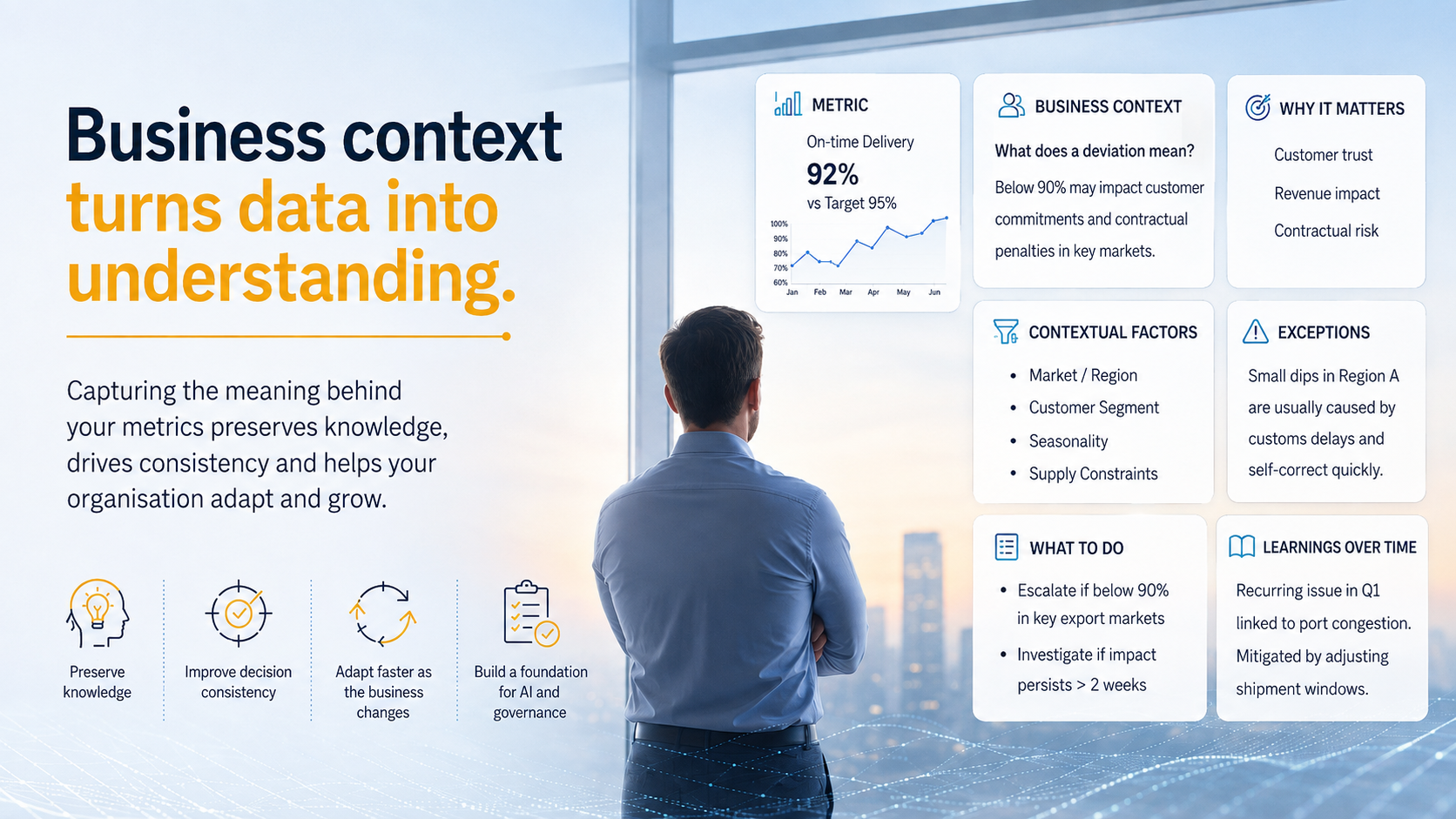
Business Context as Organisational Memory
Most organisations have become very good at preserving data.
- Transactions are stored.
- Metrics are defined.
- Dashboards are maintained.
- Processes are documented.
- Calculation logic is captured.
But much of what makes that information genuinely useful still sits somewhere else. It sits in people’s heads.
An experienced business leader does not simply know that a metric has moved. They know whether the movement matters. They know whether a 5% deviation is routine or serious. They understand what may have caused it, which downstream areas could be affected, when intervention is needed, and which apparent exceptions can safely be ignored.
This understanding is rarely contained in the metric itself. This understanding is contained in the business context.
Data is not the same as understanding
- A Metric can tell us what happened.
- Its Definition can tell us what the metric represents.
- Its Formula can tell us how it was calculated.
But none of those necessarily tell us what the result means to the organisation.
Consider a simple operational measure such as late deliveries.
The organisation may know exactly how the metric is calculated.
But an experienced leader may also know that a small deterioration in the Domestic Market is relatively harmless, while the same deterioration in the Export market could result in contractual penalties, missed export windows, customer escalation or lost revenue.
The numbers may be identical, The business meaning is not.
This distinction matters because organisations often preserve the the data, the definitions and the calculations very well. But the context needed to understand why the distinction matters is often far less well preserved.
There is another consequence too. When business context is not explicit, different teams or leaders can interpret the same information differently. The metric may be consistent, but the judgement applied to it may not be. Capturing that context can therefore help organisations make decisions more consistently without removing the room for experience and judgement.
The problem with tacit knowledge
Over time, experienced people build up an extraordinary amount of contextual knowledge.
- They learn which signals matter.
- They recognise patterns before they become obvious.
- They understand why certain thresholds exist.
- They know the exceptions to the rules and, just as importantly, why those exceptions exist.
Much of this knowledge is acquired gradually through decisions, mistakes, conversations and experience.
And much of it remains undocumented.
This creates a hidden dependency.
When a leader changes role, retires or leaves the organisation, the data remains. The reports remain. The dashboards remain.
But some of the understanding disappears.
The incoming leader then has to reconstruct it.
They speak to colleagues. They observe patterns. They make decisions. Sometimes they make mistakes. Gradually, they rediscover what the organisation already knew.
This is not really learning. It is relearning.
Leadership transition should not mean business rediscovery
There will always be a learning curve when someone new joins an organisation. That is inevitable and often useful.
But there is a difference between learning a business and rediscovering knowledge that already existed.
If important business context were captured alongside the data itself, the new leader could begin from a much stronger starting point.
They could understand not only:
- what a metric is
- how it is calculated
- who owns it
but also:
- what a meaningful deviation looks like
- what that deviation may indicate
- why it matters
- what business impact it can create
- which contextual factors affect its interpretation
- what the organisation has learned about it over time
This changes the nature of onboarding.
Instead of spending months reconstructing the previous leader’s understanding, the new leader can start with it.
And then challenge it. Improve it. Add to it.
That is a much more valuable use of experience.
From knowledge retention to knowledge compounding
The real opportunity is not simply to preserve knowledge.
It is to compound it. Each generation of business leadership should ideally inherit the accumulated understanding of those who came before and then add its own experience.
This creates something closer to organisational memory.
The organisation no longer depends entirely on individuals remembering why something matters. Instead, part of that meaning becomes persistent. This is especially important in businesses where decisions depend heavily on experience, judgement and local context.
Manufacturing, supply chain, financial services, healthcare, retail and many other sectors contain countless examples where the formal definition of a metric tells only part of the story.
The operational meaning often comes from years of accumulated business knowledge.
If that meaning is not captured, the organisation repeatedly pays the cost of rediscovering it.
There is also a growing question of explainability.
If a decision is influenced by a particular threshold, exception or interpretation, the organisation should ideally be able to explain why that judgement was applied. Captured business context can provide part of that reasoning trail.
That has implications for accountability, governance and auditability, although each of those deserves a fuller discussion in its own right.
There is an AI implication too
This becomes even more important as organisations increasingly use AI to interpret business data.
Much of today’s discussion focuses on giving AI access to more data. That is necessary.
But access to data is not the same as access to understanding.
An AI system may know the value of a metric, how it has changed and how it compares historically. But,
- Does it know whether the change matters?
- Does it understand why one deviation deserves immediate attention while another can be ignored?
- Does it know the likely operational, financial or customer impact?
- Does it understand how the organisation itself interprets that information?
Without the context, AI may be analytically correct and still be commercially unhelpful.
This suggests that one of the next challenges in enterprise AI may not simply be data access. It may be the ability to make organisational meaning available alongside the data.
Beyond the business glossary
Business glossaries and semantic layers have already helped organisations create more consistent definitions. That is valuable. But there may be another layer still to capture.
Not just:
What does this metric mean?
But:
What does this metric mean here, in this organisation, under these circumstances?
This includes interpretation, thresholds, impact, exceptions and accumulated experience. It is the difference between defining information and preserving understanding.
Making business understanding persistent
Organisations have spent decades making their data persistent. Over time, we have built systems to store it, govern it, integrate it and analyse it.
Perhaps the next challenge is to do something similar with business context. To capture not only the numbers, but the knowledge around the numbers. Not only the metric, but why it matters. Not only the deviation, but what the organisation has learned it can mean.
Because the goal should not be to help the next leader learn what the previous leader knew. It should be to let them start where the previous leader finished.
We have made data persistent. It is time to make business understanding persistent too.
When the Business Changes, the Context Must Change With It
Knowledge retention is only one part of the challenge.
Modern organisations rarely remain static for long.
A new line of business is launched. A company is acquired. A market is entered. A supply chain changes. A regulation alters the way a process must operate. An existing business process is redesigned.
Each of these changes affects more than systems and data. It can change the meaning of the information itself.
- A metric that was previously interpreted one way may need a different threshold in a new market.
- An acquired business may use the same term but mean something different.
- A process change may alter which deviation matters, when intervention is required, or what business impact should be expected.
If that context exists only in people’s heads, adapting it becomes slow.
The organisation has to rediscover the implications of the change through discussion, experience and, sometimes, mistakes.
But if business context is already explicit, it can be extended.
The existing understanding becomes a starting point rather than something that must be reconstructed.
- A new business line can add its own interpretation.
- An acquisition can introduce additional definitions and exceptions.
- A changed process can update the meaning, thresholds and impact associated with an existing metric
This is where captured business context becomes more than organisational memory.
It becomes part of the organisation’s ability to adapt.
The question is no longer only:
How do we preserve what the business already knows?
It is also:
How quickly can we extend that knowledge when the business changes?
In a fast-moving organisation, that may be just as important.