Data-Driven Mines
Unearth your competetive advantage
Today’s fast-paced business environment requires mining industry leaders to tackle long-standing industry challenges at a pace and scale previously unseen. Immense opportunities exist for those companies capable of making dynamic decisions based on sound analysis and interpretation of data.
xLytix – Unified Data Management
Focused on data-generated insights, xLytix simplifies your data processes with automated tools designed for acquisition, modelling, transforming, documenting, deploying, and managing solutions.
Experience enhanced speed, scale, and accuracy throughout your data journey with xLytix.
Managing Diverse Data in the Mining Industry
The interplaying of advanced technologies of the Industry 4.0 (I4) mandate towards the mines of the future creates a smart connected mining industry that transforms vast amounts of data into predictive and fully integrated intelligent systems. Thus, additional safety, stability, and predictability can be achieved to maximize efficiency while minimizing operating and capital costs. In addition, the road to overcoming mining challenges is fundamentally human-centered and has inclusive socio-economic development or what is known as sustainable development (SD) at its core. Throughout the production value chain, the mining sector faces various economic, geopolitical, social, and technological hurdles. Innovative manufacturing methods are required to introduce the next digital generation into the raw material area all the way to the tailings area. In the realm of increasing process automation, I4 applications are currently trending in the mining industry.
It is well known that the mining industry today has a wealth of data from operations. This includes data related to equipment performance, orebody (resources, reserves), quality (grade), plant operations (recovery), drill & blast, energy/fuel consumption, and maintenance, to name a few elements. Most mines have implemented some form of daily and monthly reporting and wonder whether this is the right time to dive into proof of concepts on machine learning. Many do, only to later realize that these experimentations are unable to scale, had an ill-defined problem statement, are too complex to manage in the long run, lack data quality or do not provide the desired benefits. In essence, a structured approach is necessary, and application of data analytics technology should progress as the business matures, to derive insights from data for decision making.
Reducing mining operation costs is a complex task, with several factors influencing these costs. Companies in the industry must navigate challenges such as fluctuating commodity prices, labor expenses, energy consumption, regulatory compliance, and increased mineral demand while ensuring sustainable practices. Labor expenses pose a significant challenge, as mining is labor-intensive. Balancing a skilled workforce and controlling labor costs is essential for competitiveness. Moreover, mining processes like drilling, blasting, and ore processing require substantial energy. Rising energy costs and the push for sustainable energy sources complicate cost-reduction efforts. Equipment maintenance and replacement impact operational efficiency, as mining equipment ensures harsh conditions and constant wear and tear. Companies must also adhere to strict environmental and safety regulations, leading to increased operating costs as they invest in new technologies and processes. The scarcity of high-grade mineral deposits requires costly, extensive exploration efforts and sophisticated extraction methods.
Restoring Data Confidence
Using technology to produce, store and analyze data has proven to help organizations become more successful, if implemented correctly. This is particularly true in the mining industry. From the introduction of the first Fleet Management System in the 1970’s, mining companies have used an increasing number and type of technological systems to better manage operations to improve productivity and lower costs. As the overall cost of technology has decreased in recent years, there has been a revival in the concept of digitalization and data fueled by the advances in artificial intelligence (AI) and machine learning technologies. This has brought about a new generation of ideas and products specifically for use in the mining industry.
Mining operations have a wide range of activities and typically each activity has its own specialized software or system – from planning to operations, maintenance to HR, survey to processing and more. This is not a bad thing as it means each system can focus on doing exactly what it needs to, and each area can choose the right tool to suit their business needs. These disparate systems are usually supplied by different vendors, so they typically stand alone and don’t communicate or integrate with each other. Understanding how to integrate all the data produced by these systems—and more importantly—make sense of it, can create a game changing competitive advantage. The best way to integrate all the various disparate systems and data is to use a specialized data integration and data warehouse platform. However, to get to this point, we first need to trust the data we have.
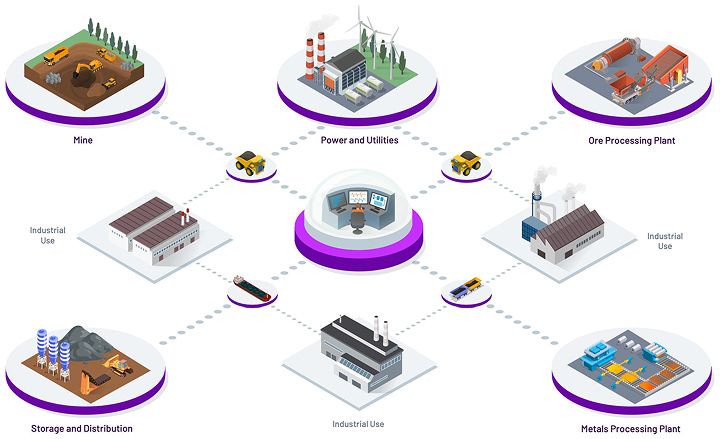
Data Management Command & Control Centre
Our aim is to provide a state-of-art data management platform for mining industry which will facilitate a better use of their data assets. As part of this solution, we will setup the data platform and more importantly, we will provide with a system which business can then intuitively use for finding new insights from the data repository investment. Our xLytix data automation platform will simplify data processes with automated tools designed for data acquisition, modelling, transformation, documentation, deploying and managing the end-to-end data platform. Having xLytix as the unified data management tool will accelerate data democratisation vision much quicker than traditional approaches to developing a data warehouse.
Central Data Repository
Collecting and managing data in the most crucial part of the data strategy which provides a foundation to all the future advancement of data analytics possibilities.
Companies often invest significant time, resources, and money into building an Enterprise Data Warehouse (EDW). However, these systems are usually only understood by technical experts, leaving business teams struggling to create new use cases and ideas. This creates a major bottleneck in today’s competitive market, causing many businesses to revert to spreadsheets like Microsoft Excel as their go-to tool for managing data and generating insights.
The choice often becomes either manual data handling with spreadsheets or creating a fully customized BI solution — neither of which is ideal for most organizations.
There is a third option – an off-the-shelf product: a specialized data intelligence platform that collects, validates, augments and normalizes data from the end user to consume in whatever format they require the data. This is available through UXLI’s xLytix Unified Data Management Platform.
Our Solution helps you meet your objectives
01
Build your industrial information infrastructure
Establish a solid foundation for all your digital transformation initiatives by integrating and contextualizing all sources of engineering and operations data to centralize information and foster a data-driven decision culture.
02
Enable full visibility and awareness
Creating a single-pane-of-glass that can break down functional silos and speed informed decision- making by providing visibility tailored to a user’s specific role.
03
Optimize your production and value chainfrastructure
Enhance your operational execution, process optimization, production management, feedstock management, and supply-chain planning and scheduling capabilities
04
Increase asset health and performance
Improve reliability and identify areas for condition-based, predictive and prescriptive maintenance strategies to be adopted. Improve your asset strategy, asset analytics, and maintenance execution.
05
Streamline engineering and capital project execution
Break down silos between process, mechanical and other engineering disciplines to enable seamless data collaboration across teams and unify your approach to all aspects of value chain lifecycle.
06
Accelerate Learning
Bring agility to the learning process. Enable teams with digital data repository to be able to analyze and drive towards a datadriven organization.
xLytix – Unified Platform
xLytix will eliminate much of the manual effort and coding required to design, build, manage, operate and document data warehouse and data marts.
xLytix will offer numerous benefits to HIL by streamlining and enhancing the data warehousing processes:
- Improved Efficiency and Speed
- Cost Savings
- Enhanced Data Quality and Consistency
- Improved Data Governance and Compliance
- Agility and Flexibility
- Enhanced Collaboration
- Focus on Strategic Tasks
xLytix provides a self-service data management platform where a business analyst can develop their use cases without the need to know all the technical details of the underlying systems. The biggest advantage is having one single Integrated Development Environment (IDE) where you can perform all the core data management activities starting from collecting data from various sources, cleanse and model your data, and analyze and visualize your data. This will hugely improve your data analyst’s productivity and help you to develop new use cases with lightning speed.
xLytix – Unified Data Product Builder
xLytix will provide a central web-based IDE to perform all relevant activities related to data platform management. More details of XLytix functions and features are available at www.xlytix.com.

Rapid Creation and Modification
Accelerate data product development, adapting swiftly to business needs

Low-Code Interface
Easily create and customize data products with intuitive drag-and-drop features.

AI-Powered Code
Automated code generation, simplifying complex tasks for efficiency and precision.

Data Transformation
Refine data effortlessly to match business needs, saving time and effort.

Dimensional Modelling
Develop comprehensive data models for confident, insight-driven decisions

Semantic Layer
Establish a clear data structure for enhanced accessibility and accuracy.

Data Quality
Ensure trustworthy decision-making with built-in data quality enhancements.

Data Observability
Gain transparency into data workflows through detailed monitoring & tracking.
Data Automation made Simple
Using xLytix as a central integrated development platform for all end-toend data management activities, we believe HIL will be able to quickly harvest the following benefits from its data transformation program:
- A data management system that is easy, accurate, timely, reli able and scalable.
- Transformed data to allow for more natural relationships and
simplified search parameters. - Cost effective, intuitive tools for data and business analysts.
- Rapid adoption and enhancement of data driven use cases.
- Service efficiencies and overall cost reduction.
80%
Time-Savings
on hand-coding development, refactoring and management tasks.
8x
Productivity
in implementing your data products through automation.
6x
ROI
by avoiding failures, standardisation and built-in best practices.